How to Conquer Borneo’s Relentless Humidity: The 2026 Borneo International Marathon Training Guide
The Borneo International Marathon (BIM) in Sabah is more than a race; it is a physiological chess match against the equatorial sun. Since its resurgence in 2008 by the Kinabalu Running Club, this event has earned its reputation as one of the most beautiful—yet punishing—marathons in Southeast Asia.
To finish strong in Kota Kinabalu, you need more than miles in your legs. You need a specialized strategy for heat, humidity, and hydration.
The Sweaty Science: Why Borneo is Different
Running in the tropics introduces a variable that dry-climate runners rarely face: the evaporation trap. In a typical environment, your body cools down when sweat evaporates from your skin. However, when humidity levels hit 90%, the air is already saturated with moisture. Your sweat has nowhere to go. It drips off your body without providing any cooling effect, leading to “wasted sweat” and a skyrocketing core temperature.
The WBGT Factor
Modern endurance athletes no longer look at the thermometer alone; they monitor the Wet Bulb Globe Temperature (WBGT). This metric accounts for temperature, humidity, wind speed, and solar radiation.
- Green/Yellow Flag: Proceed with caution.
- Black Flag (Above 28°C/82°F WBGT): High risk of heatstroke.
For the BIM, expect conditions to push into the high-caution zone by 7:30 AM.
Understanding WBGT (Safety) National Weather Service: WBGT Guide
The 14-Day Heat Acclimatization (HA) Protocol

You cannot “tough out” the heat; you must adapt to it. Research shows that a structured 14-day protocol can lower your resting core temperature and increase your sweat rate.
Phase 1: Easy Efforts (Days 1–5)
Keep your intensity at 50-60%. Your heart rate will naturally be 10–15 beats per minute higher than usual. Focus on “time on feet” rather than pace.
Phase 2: Humidity Blocks (Days 6–10)
Introduce 15-minute intervals at your goal marathon pace. This teaches your body to manage higher internal thermal loads while under external stress.
Phase 3: The Race Pace Calibration (Days 11–14)
If you are traveling from a temperate climate (Europe, US, or Southern Australia), use passive heating. Spend 15–20 minutes in a sauna or hot bath post-run to maintain the plasma volume expansion triggered by your earlier training.
Pacing Strategy: The “Dew Point” Adjustment
Do not chase your PB (Personal Best) from a London or Berlin marathon in Borneo. To avoid “hitting the wall” at kilometer 25, use the Temperature + Dew Point formula to adjust your target pace.
| Sum (Temp °F + Dew Point) | Required Pace Adjustment | Risk Level |
| Below 100 | No adjustment needed | Low |
| 101 – 125 | 0% – 1% slower | Minimal |
| 126 – 140 | 1% – 3% slower | Moderate |
| 141 – 150 | 3.0% – 4.5% slower | High |
| 151 – 160 | 5% – 8% slower | Very High |
| Above 160 | Hard efforts not recommended | Dangerous |
Pro Tip: In Kota Kinabalu, the “Temp + Dew Point” sum often exceeds 150 by mid-morning. Consequently, if your goal pace is 5:00/km, you should adjust to 5:15/km or 5:20/km. Therefore, slowing down early is the only way to ensure a safe finish as the humidity rises.
Hydration: Your Lifeline in Sabah
1. Pre-Loading with Sodium
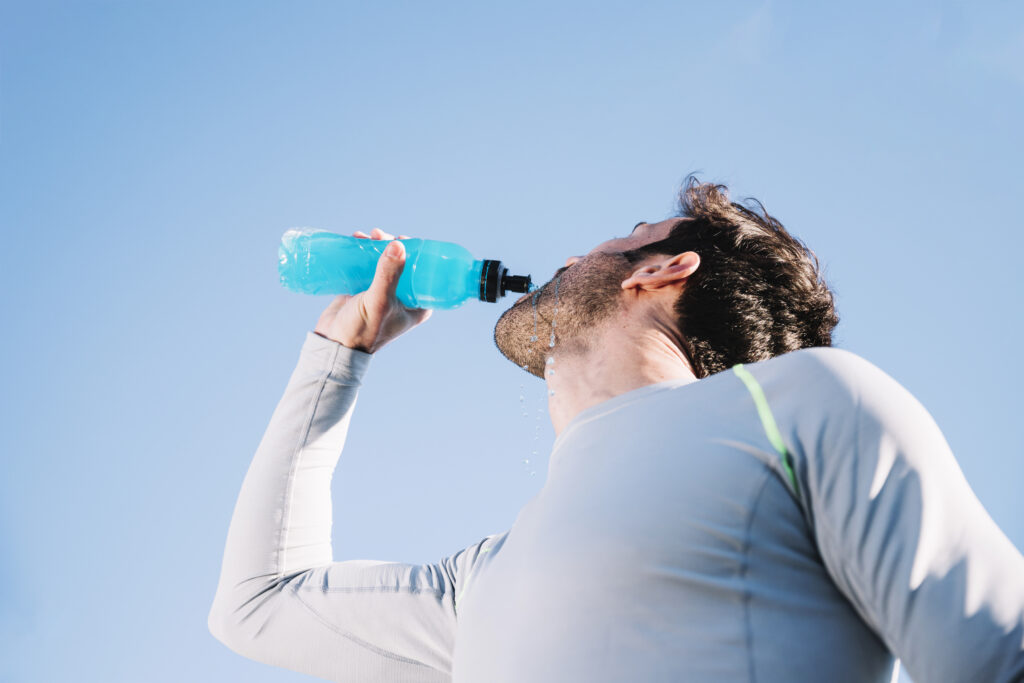
Plain water is your enemy if consumed in excess without electrolytes. This can lead to hyponatremia (dangerously low blood sodium). Aim for 500–700mg of sodium per liter of fluid.
2. The Sweat Rate Test
To know how much to drink, weigh yourself (naked) before and after a 60-minute run.
- The Formula: (Weight Before – Weight After) + Fluid Intake during run = Total Sweat Loss.
- The Danger Zone: Losing more than 2% of your body weight during the race indicates critical dehydration.
3. The Ice Slurry Protocol
Ingesting an ice slurry (crushed ice drink) 20 minutes before the start acts as an internal “heat sink.” It lowers your core temperature, giving you a larger “thermal buffer” before you reach the point of exhaustion.
Essential Gear for Tropical Racing
- Open-Mesh Fabrics: Forget “moisture-wicking” polyester; look for wide-mesh singlets that allow maximum airflow.
- Ice Bandanas: Use the aid stations. Wrap ice in a bandana around your neck. The cooling of the carotid arteries sends a “cool” signal to the brain, lowering perceived exertion.
- Sizing Up: Heat causes peripheral vasodilation (swelling). Ensure your race shoes are a half-size larger than your standard trainers to accommodate foot swelling.
Where to Train in Kota Kinabalu

If you arrive early for the race, these are the best spots to log your final taper miles:
- Perdana Park (Tanjung Aru): A 1.8km rubberized track. It is perfectly flat and features water stations and clean facilities.
- Likas Bay Track: A 4.3km flat polymer surface. It offers stunning views of the City Mosque and is well-lit for those 4:00 AM “heat prep” runs.
- Tanjung Aru Beach: For a recovery shake-out run, the firm sand at low tide provides a low-impact surface with a refreshing sea breeze.
FAQ: Frequently Asked Questions
What time does the Borneo International Marathon start? Usually, the Full Marathon starts at 2:00 AM or 3:00 AM to take advantage of the coolest hours of the night. Always check the official BIM website for updated flag-off times.
What are the signs of heat exhaustion? Stop immediately if you experience dizziness, nausea, or most critically – goosebumps/chills while in the heat. This indicates your cooling system has failed.
Is there a cut-off time for the BIM? Yes, typically the cut-off for the Full Marathon is 7 to 8 hours. This is strictly enforced due to the rising temperatures after 9:00 AM.
The Finish Line: Respect the Humidity, Own the Race
The 2026 Borneo International Marathon is a test of science, not just grit. By using a 14-day protocol, you transform the humidity into a manageable variable. Therefore, trust your pace adjustments to ensure a safe finish. See you at the 2:00 AM start – stay cool and run your own race.